
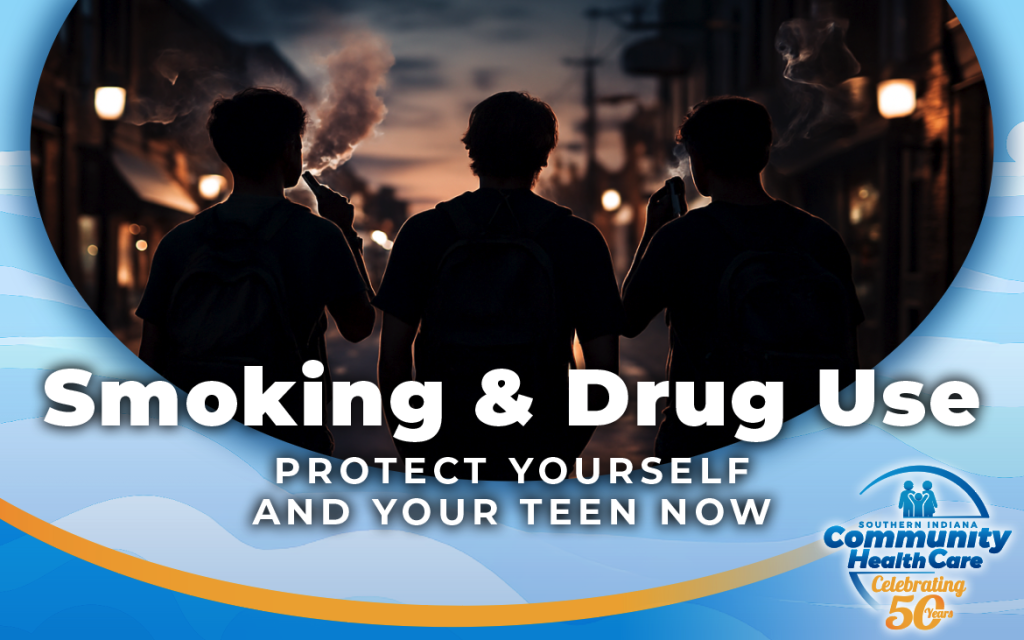
Smoking and drug use – protect yourself and your teen now
By Curtis Thill, M.D.
The front-page article in a recent Wall Street Journal summed it up: “The stars are lighting up again.” The coverage chronicled how pop stars and several recent movies in 2025 were effectively eroding “a years-long decline in U.S. smoking rates” by displaying smoking as an acceptable social element, essentially promoting its use. As one health care expert warned about the power of popular role models in today’s society, “I find that concerning – glamorous, attractive people smoking cigarettes.”
Why should people be concerned about this? Is smoking really all that bad?
As a long-time practicing physician in southern Indiana, I emphatically agree – smoking is really not a good habit or option for people of any age, but especially for young people.
Fortunately, strong efforts are underway in our healthcare service area – a region known in the past for unhealthy tobacco and related use – to educate and warn our people about the dangers of smoking and tobacco use.
What an EMT sees on the job
Stephen Parrott, a certified Emergency Medical Technician (EMT) with 28 years of experience, is bringing his high-voltage “Tough Talk” to the area, recently speaking to high school students in Crawford, Lawrence, and Orange Counties. Five years ago Parrott – whose day job is serving as a field supervisor for the third largest ambulance service in Kentucky – started presenting programs about drug awareness in local high schools in Indiana and Kentucky, based on his personal experience of treating teens who have overdosed or are addicted. Here are some excerpts of his key messages:
“Many teenagers continually use and experiment with drugs, not knowing what counterfeit drugs may be in what they’re taking, including deadly fentanyl,” he explains. As his contact with high school students expanded, he learned about a critical pathway: “everything starts with experimenting with tobacco.”
Some 35% of teenagers who use substances first started with using tobacco for the nicotine effects of dopamine production in their brain. Many teenagers face conflicting emotions, anxiety, social pressure, and other issues. When they find that nicotine in tobacco can temporarily accelerate the production of dopamine – “that’s the euphoria neurotransmitter that makes people feel good,” he said. “Teens start chasing that high and get their dopamine dump.”
The problem? The body gets used to the nicotine boost, so teens can start experimenting with other drugs, causing a whole host of other issues. Even vaping cartridges can pose major problems, as teens who buy vaping products on the street often have no idea what they are actually buying.
Sadly, when experimentation rises to this level, deadly fentanyl can be introduced as a counterfeit to what a teen or young person may actually think they’re buying or using. The result can quickly turn tragic.
The toughest part
“I ask students what they think is the toughest part of my job,” Parrott said. “They often say responding to car crashes or other major accidents. That’s bad for certain, but that’s not the worst part of my job.”
The most difficult and hard part? “The toughest part of my job is when I have to tell a parent that their child is dead because they accidentally overdosed on illegal fentanyl or some other substance.”
A critical element? “As parents or caregivers, we all have to remember that we were all young once – ten feet tall and bulletproof – or so we thought.” Parents “have to support teens in providing education about the dangers of substance use, including starting with tobacco and vaping.”
“My presentations to high school students are called ‘Tough Talks’ and there’s a reason for that. It’s not easy to talk about these things, but it’s critically important.”
The point? Like Parrott’s EMT experience, I have seen the terrible effects in my healthcare career. Tobacco use or vaping is not safe. If you or a friend or loved one is using substances, help is available. Don’t wait for the tragic accident – find a trustworthy source and protect yourself, even if the pop stars are not in alignment.
Finally, know a smoker who wants to quit? Contact any of our SICHC offices for a free Quit Kit – all inquiries are confidential (visit https://sichc.org/ for location information).
A board-certified family physician, Dr. Curtis Thill has practiced medicine in Crawford County for more than 30 years.
Social Media


